EN
EN

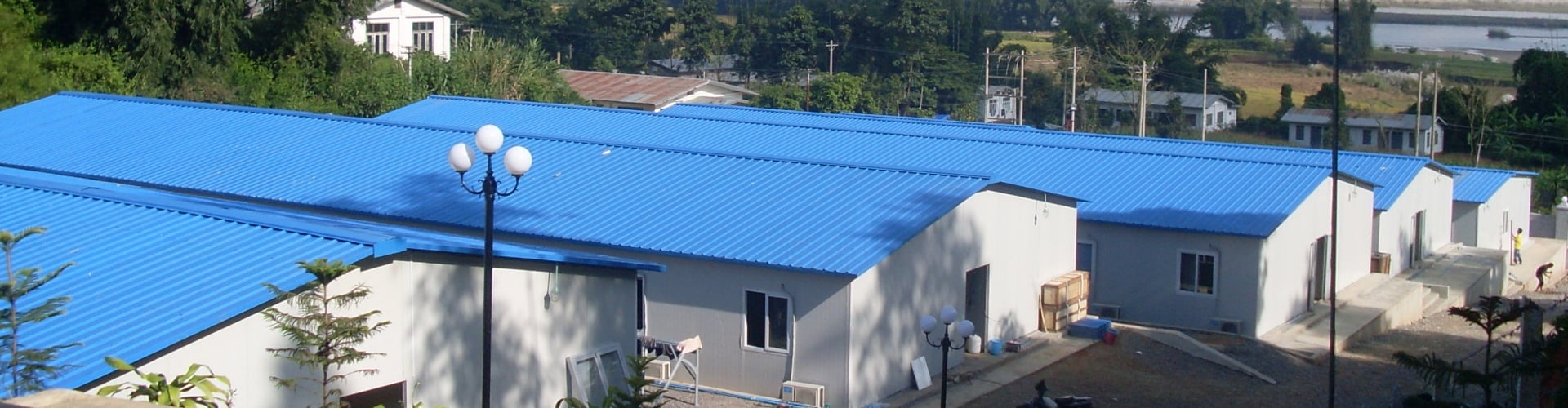
Castra Modularia Translatilia: ROI pro Proiectis Multifasibus
Plurimi conductoris castrum operariorum emunt, semel utuntur, et destruunt. In programma multi-phasicum vel seriali-proiecto, hoc consuetudo silentio perdit miliones in capitali. A relocabilis modularis castra modelum invertit: eadem dormitoria, officia, coquinae et ablutionis structurae sunt ita constructae ut dissolvantur, transportentur et in proximo situs rursus erigantur — habitatio temporaria situs ex deductione in reusabilem bonum in tabula aequilibrii convertens quod saepe totalem habitatio pretium per tres proiectos 35–50% minuit.
Hoc manuale explicat quid castrum vere relocabile faciat, quae flat pack accommodation units et les modules conteneurs font le travail, comment un déplacement se déroule réellement semaine après semaine, et à quoi ressemble le retour sur investissement avec des chiffres réels — tirés de l'expérience du CDPH dans la fourniture d'hébergements pour les travailleurs dans plus de 100 pays.
1. Pourquoi l'économie des camps détermine les offres de projet
Sur les appels d'offres pour les travaux miniers, énergétiques et d'infrastructure, le coût des camps ne fait presque jamais perdre une offre en soi — mais il en érode régulièrement une. La raison est structurelle : les camps sont traités comme une dépense par projet, reconstruits entièrement à chaque fois, tandis que leur coût réel se mesure sur l'ensemble du programme.
Plus un entrepreneur gère de projets, plus la valeur passe du prix d'achat d'un seul camp vers l'économie de cycle de vie d'une flotte de camps. Tel est le compromis qu'un camp relocalisable bien conçu réalise — et pourquoi les entrepreneurs menant des programmes successifs dans les secteurs minier, pétrolier et gazier, ainsi que dans les infrastructures, considèrent de plus en plus l'hébergement des travailleurs comme un équipement, et non comme un consommable.
2. Qu'est-ce qui rend un camp véritablement relocalisable Re-erection of a prefabricated modular dormitory cabin at a new project site — one crane, one small crew.
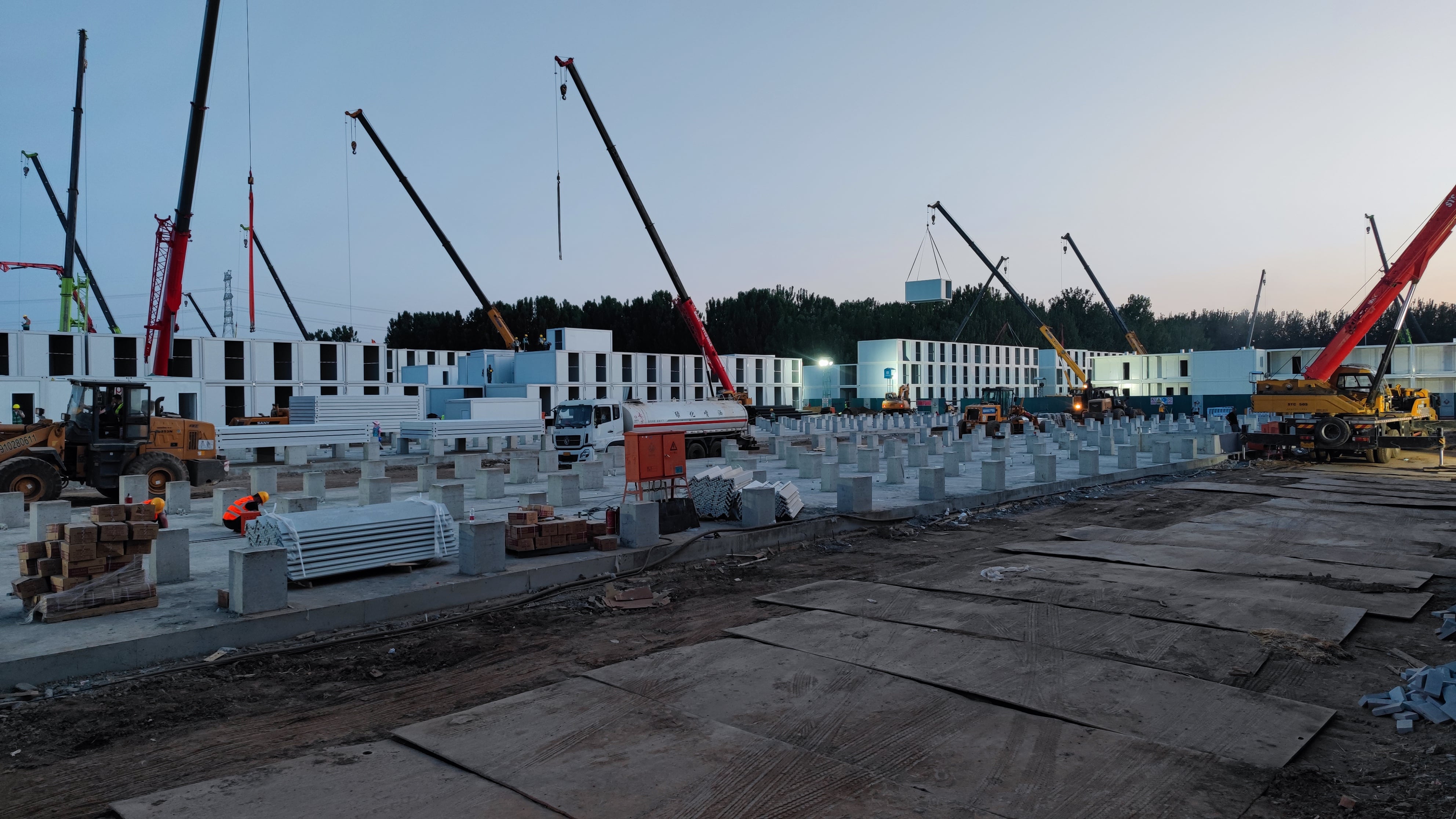
Not every prefab building survives a second erection. Relocatability is designed in from the first sketch, and it rests on five principles:
- Through-bolted connections, not site welds. Every structural joint is a bolted connection specified for repeated assembly and disassembly, per execution-class steelwork practice. Welded frames crack coatings and lose strength at each cut-and-re weld; bolted frames do not.
- Liftable, stackable modules. Units carry reinforced corner castings and frame points rated for repeated crane lifts and road transport, so handling is routine logistics rather than delicate surgery.
- Flat-pack panel construction for volume scope. Dormitory walls, roofs and floors ship as nested flat-pack bundles — a 40 m container carries the envelope of a full sleeping block, slashing freight cost per bed.
- Standardized utilities. Electrical, water and drainage interfaces use the same connector positions across every unit in the fleet, so re-erection is plugging in, not re-engineering.
- Recoatable steel envelope. The structure is blasted and coated in the factory with a system selected per the harshest environment on the programme — up to C5-M for coastal and offshore-adjacent projects — and can be re-coated between deployments instead of replaced.
A camp built on these principles is designed for 3–5 full relocation cycles over a 15–20 year service life . A camp built without them is disposable no matter what the brochure says.
3. The Relocatable Product Range Flat-pack accommodation unit bundles loaded for container shipping — the high-volume, low-freight way to move a camp.
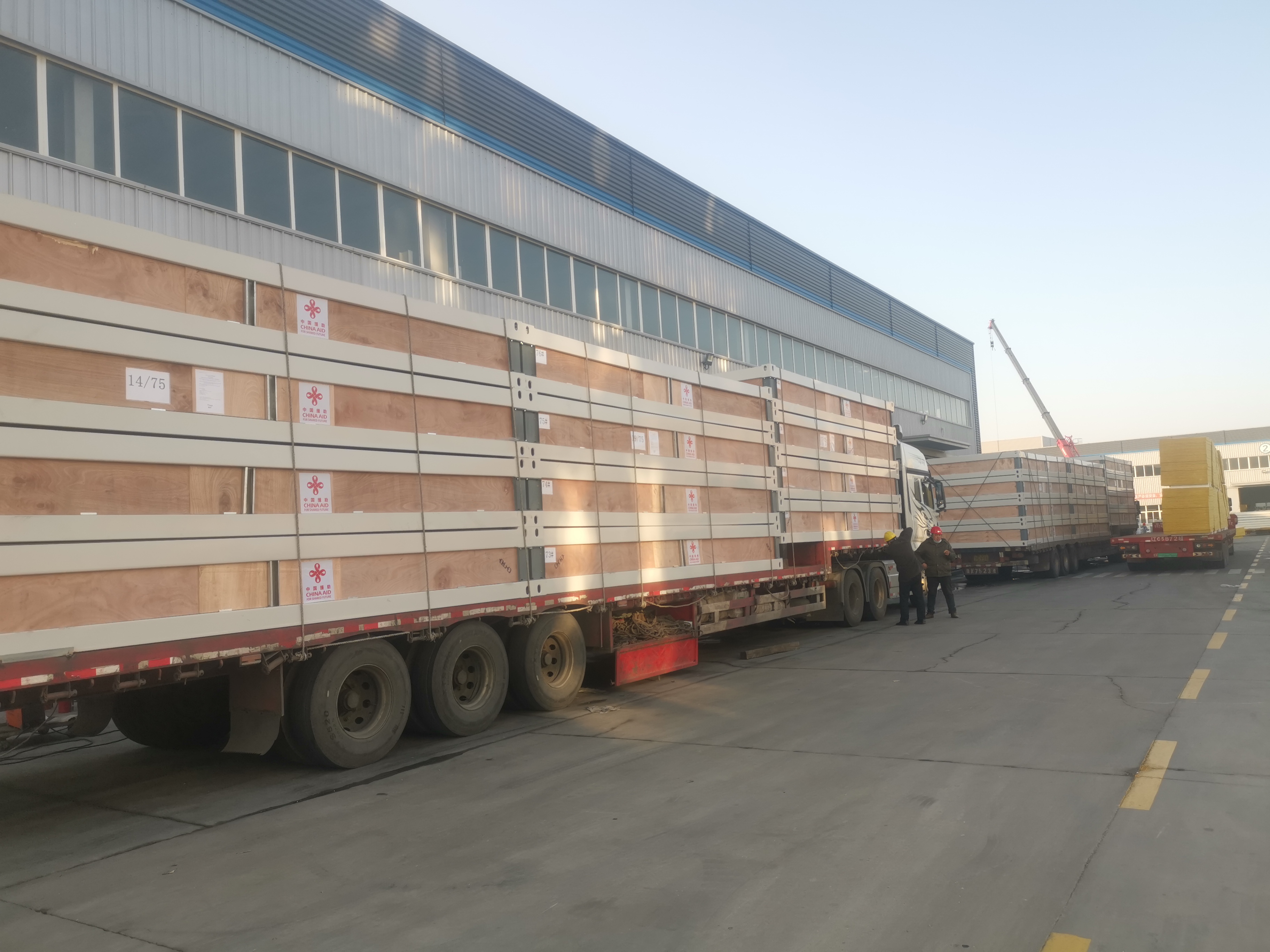
A complete camp is a fleet of complementary unit types. CDPH delivers the full range from one engineering platform, all relocation-grade:
- Flat pack accommodation units — the workhorse for dormitoria Operariorum et modular labour room blocks; nested panels minimize shipping volume and a four-person crew erects a sleeping block in days
- Container dormitories and accommodation containers — ISO-corner dormitory container house units for fast lift-and-shift deployment, available as accommodation containers for sale individually or as full camp scopes
- Volumetric wet modules — kitchens, dining halls, ablution and laundry blocks installed at factory, with plumbing pre-installed, tested and commissioned before shipping
- Portable office accommodation — site offices, meeting rooms, clinics and control rooms as relocatable single units or linked multi-unit suites
- Recreation and welfare buildings — gyms, canteens, shops and activity rooms that keep a remote workforce stable and retained
- Steel warehouses and dry stores — bolted clear-span stores that relocate with the same logic as the camp around them Dormitory interior of a relocatable modular unit — insulated, air-conditioned and furnished for remote workforce accommodation.
Procuring the whole fleet from one supplier has a practical benefit beyond price: interfaces are designed, not negotiated. Dormitories, kitchens, offices and warehouses share connection logic, utility routing and detailing standards — and arrive on one coordinated delivery plan per project phase.
4. Relocation Workflow and Timeline The same camp re-erected at its second project location — a gold mine in Africa.
Relocation is a planned logistics operation, not a salvage job. For a 300-person camp, the typical programme looks like this:
|
Phasis |
Duration (300-person camp) |
Acta Principalia |
|
Condition survey & dismantling plan |
1 hebdomada |
Structural and coating inspection, unit tagging, packing sequence, refurbishment list |
|
Dismantling & packing |
1–2 hebdomadae |
Unit disconnection, panel bundling, MEP capping, moisture protection, container loading |
|
Transport to next site |
1–3 hebdomades (secundum distantiam) |
Vectura per viam terrestrem aut per mare fasciculorum in modulis planis, modulorum in containeribus et depositis ferreis |
|
Fundamenta et restitutio |
2–3 hebdomadis |
Platae ex grava aut fulcra regolabilia, collocatio unitatum, coniunctio tabularum, alligatio ad utilitates |
|
Restitutio functionis et traditio |
1 hebdomada |
Examinatio systematum mechanico-electrico-plumborum, renovatio stratorum, elenchi defectuum, traditio pro occupatione |
Summa: fere 5–9 hebdomades a conclusione ad redintegrationem occupationis . Praecipuum praevalebit super novam acquisitionem est quod nulla expectatio in fabrica necessaria est — castra iam exstant et statim in partes logisticae transferuntur. Et quia unitates sunt normatae, eadem turbae ponentium et eadem schemata sublevandi in omni expeditione repetuntur, cum qualitate praedicta.
5. Argumentum de reditu investitionis: Unum castrum, tres expeditiones
Relocation economics are easiest to see with a worked model. The comparison below uses an illustrative 300-person camp deployed on three successive projects over seven years, with costs indexed to one new single-use camp = 100 per project. Actual figures vary by scope and region — CDPH's design team models each client's programme specifically — but the structure of the result is robust:
|
Elementum Pretii |
Buy-new per project (3 × single-use camps) |
Relocatable camp (buy once, redeploy ×2) |
|
Camp supply (indexed) |
100 + 100 + 100 = 300 |
130 (one relocation-grade purchase, ~25–30% premium) |
|
Dismantle & re-erect |
— (included in demolition write-off) |
24 (2 × 12) |
|
Transport between projects |
— |
12 (2 × 6) |
|
Refurbishment & re-coating |
— |
10 (2 × 5) |
|
Programme total |
300 |
176 — ≈41% lower |
|
Residual value at programme end |
0 |
≈45% of initial purchase — saleable, rentable or deployable again |
Three second-order effects strengthen the case further. Schedula : skipping the factory queue at each new phase protects mobilization dates, and in bid terms a proven, immediately available camp fleet is a competitive differentiator. Consistentia : identical units mean identical maintenance, spare parts and erection methods across the programme. Budgeting : accommodation cost converts from three lumpy, uncertain procurements into one amortized asset with predictable relocation costs — which finance teams and auditors invariably prefer.
6. Design Decisions That Protect Residual Value
A relocatable camp is only an asset if it survives its journeys in condition. The specification decisions that protect value across relocations:
- Corrosion protection for the harshest stop on the route. The coating system is selected per ISO 12944 for the most aggressive environment the fleet will touch — C4 or C5-M for coastal and industrial exposure, with hot-dip galvanized secondary steel — so a camp that serves a desert project then a coastal one does not age prematurely.
- Cold-grade and climate packages where needed. -50°C cold packages with 100–150 mm insulated panels, desert UV-stable systems and high-plateau packages are selectable per project, applied at the factory rather than patched in the field.
- Connection wear management. Iuncturae concretae et angulares adhibentur pro cyclis repetitis et inspiciuntur in omni inspectione; clavos consumibiles substituuntur, membra structuralia non.
- Documentatio ut pars producti. Omnis unitas suos habet schemata erectionis, notae onerum, tabulae utilitatum et registra tegumentorum — fasciculus qui tertiam deploymentem tam celerem facit quam primam, et valorem residuum in venditione secundum sustinet.
- Reservatae partes normalizatae per totam classem. Unus typus tabulae, unus typus fenestrae, unum apparatus ianuarum per totam classem dimidiat inventarium reficiendi quod conductor tenere debet.
Principium subiacens: designare pro tota vita classis, non pro projecto primo. Hoc est quod separat a relocalisable a casula vilissima quae tantum portabilis videtur.
7. Probata per plus quam 100 nationes
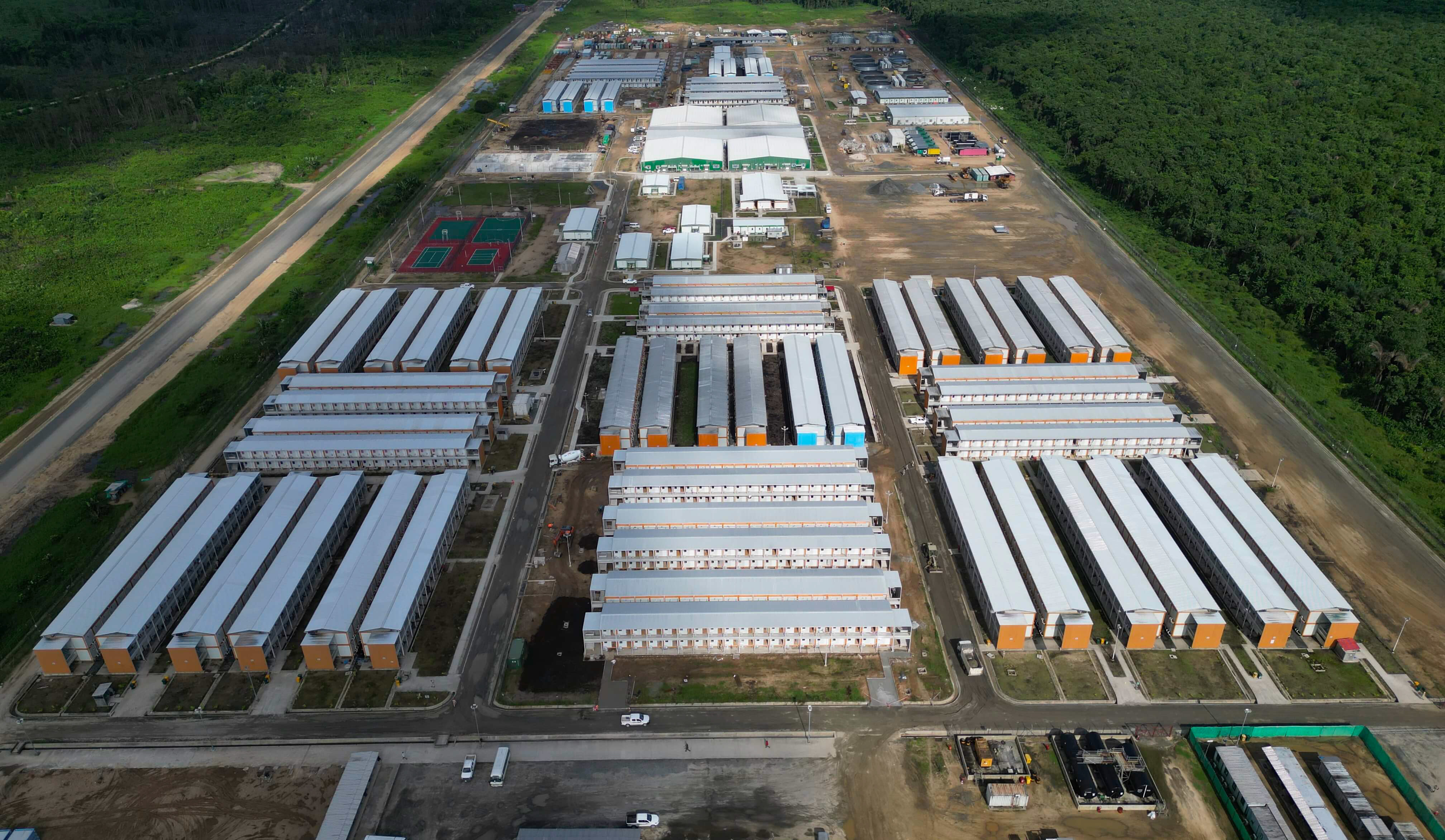
Aeconomia relocationis probata est in campo, non in tabellis calculi. 100 nationes et 5 000+ projecta tradita , CDPH workforce accommodation camps and steel buildings operate on mining, energy and infrastructure sites worldwide — from coal-fired power projects in Pakistan to oil and gas fields in the Middle East, mining camps across Africa and Central Asia, and island resorts in the Indian Ocean, where every structure arrives by barge and nothing can be built conventionally.
Because the same engineering platform covers the full climate spectrum — frigus extremum ad −50 °C , desert heat, high plateau and C4/C5-M coastal corrosion — a contractor can standardize one relocatable camp fleet and deploy it from a Saharan solar site to a coastal LNG terminal without re-engineering the product between stops.
8. Why Contractors Choose CDPH
- 3 large intelligent production factories — capacity headroom that protects your schedule, with batch-to-batch welding and coating consistency that field fabrication cannot hold
- 100+ professional designers — full structural and MEP engineering plus camp Master Planning , including the relocation sequencing and utility standardization a fleet strategy requires
- 100+ nationes, 5 000+ projecta tradita — references across mining, oil and gas, power and infrastructure sites on five continents
- Ingenium pro ambientibus extremis ut norma — -50°C cold packages, desert packages, high-plateau packages and C4/C5-M marine corrosion packages selectable per project and per deployment
- Complete site infrastructure from one supplier — flat-pack accommodation units, container dormitories, offices, kitchens and steel warehouses on one coordinated delivery plan, engineered to move together
Quaestiones Frequenter Rogatae
What is a relocatable camp?
A relocatable camp is a workforce accommodation camp engineered from bolted, modular components — flat-pack panel units, container-based dormitories and volumetric modules — designed to be dismantled, transported and re-erected on a new site rather than demolished at project end. Factory-finished units with matched connections preserve most of the camp's value across relocations.
How many times can a modular camp be relocated?
A properly engineered relocatable modular camp is typically designed for 3–5 full relocation cycles over a 15–20 year service life. The limiting factors are coating condition, connection wear and panel edge integrity — which is why camp-grade units use through-bolted frames, reinforced corner castings for lifting, and recoatable steel envelopes, with a condition survey before each move.
How long does it take to relocate a labour camp?
For a 300-person camp: 1 week for the survey and dismantling plan, 1–2 weeks to dismantle and pack, 1–3 weeks of transport, and 2–3 weeks for foundations and re-erection — roughly 5–9 weeks total. No factory queue is involved, because the camp already exists and moves straight into logistics.
Is a relocatable camp cheaper than building new each time?
In three or more projects, typically 35–50% lower total cost of ownership. A relocation-grade camp carries a purchase premium of roughly 25–30% over a single-use camp, repaid from the second deployment onward — and the camp still holds residual value at the end of the programme.
Which buildings in a camp can be made relocatable?
The full camp scope: worker dormitories, site offices, kitchens and dining halls, ablution and laundry blocks, clinics, recreation buildings, dry stores and steel warehouses. Flat-pack panel units handle the high-volume dormitory scope most economically, while container-based and volumetric modules suit wet cells, kitchens and offices with factory-fitted MEP.
Plan a Relocatable Camp Fleet for Your Programme
Si vos administratis mine multiphase, programma energiae, aut portfolium constructionis serialis, mitte ad CDPH numeros personae laborantis, ordinem operum, et datas mobilizationis praefinitas. Egregius nostrus turma designis redibit propositionem pro castris mobilibus — mixturam unitatum, divisionem inter castra plana et castra in contentoribus, modum relocationis, et modellem ROI specificum pro programma — saepe intra unam hebdomadam. Loquere hodie cum specialista castrorum relocabilium et desine solvere pro eodem castris bis.